Turn any rug over. The back tells you more than the front ever will. In a genuine hand-knotted piece, you'll see the pattern echoed in thousands of individual knots, slightly irregular, alive. A printed or machine-made rug shows a flat, uniform grid — perfect in the way only a machine is perfect.
Count the knots across an inch. A village Heriz might carry sixty to the square inch; a fine Tabriz, four hundred; a Art Silk / Silk-Like Fiber Kashan, six hundred or more. Higher isn't always better — it's a measure of intention, not of soul. A coarse tribal rug can move you more than a flawless workshop piece.
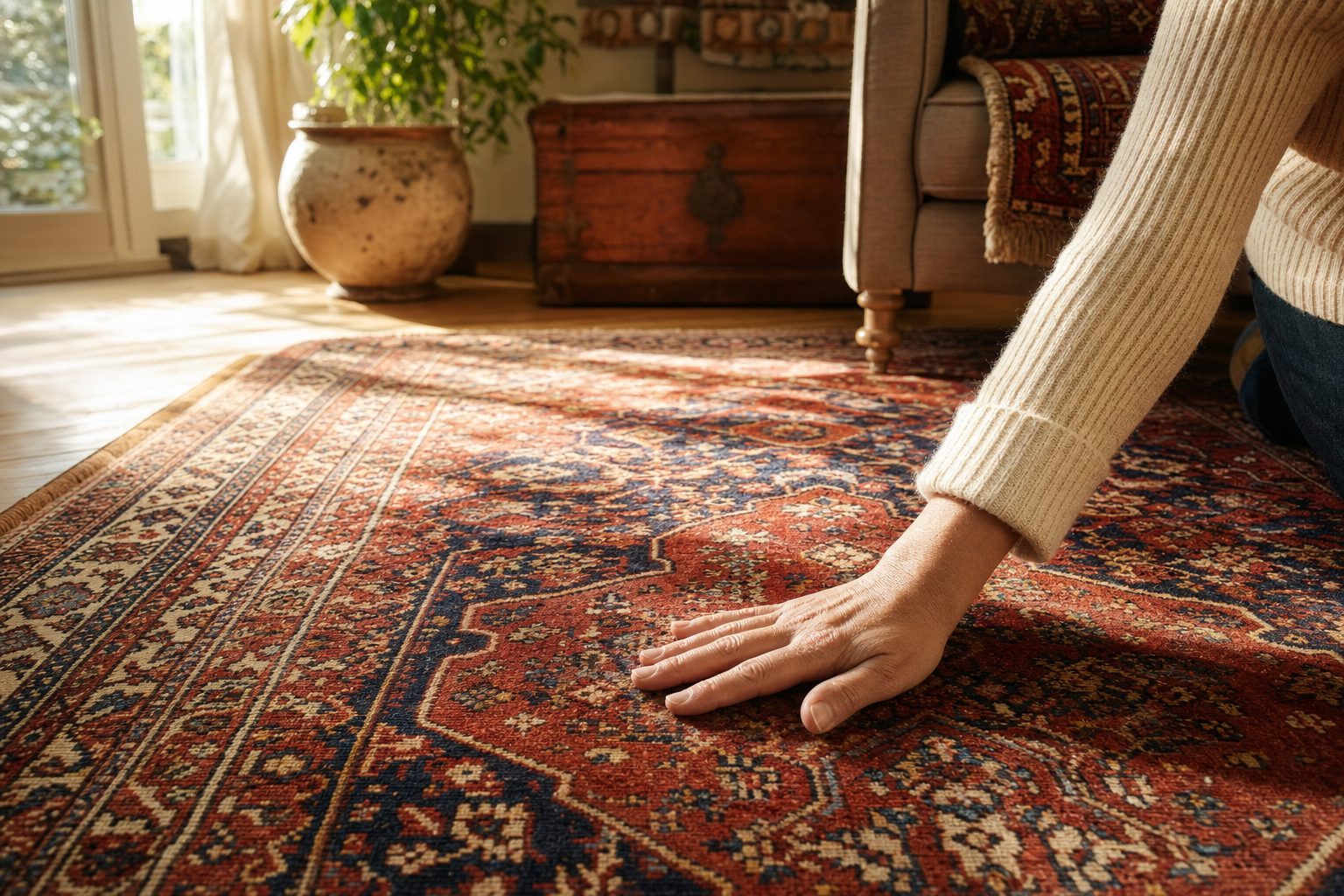
Then the wool. Run your hand across the pile. Good wool has lanolin still in it — a faint sheen, a cool slip under the fingers. Dry, brittle, chalky wool has been over-washed or came from a poor clip. And the color: natural dyes shift gently across the field (we call it abrash), because no two dye lots are identical. That unevenness is not a flaw. It is the fingerprint of the human hand.