How to Tell a Handmade Rug From a Machine-Made One
You've spotted a rug that stops you in your tracks — rich color, intricate pattern, a pile that looks impossibly lush. The tag says "handmade," but how do you actually know? In a market flooded with machine-woven reproductions that convincingly mimic the look of hand-knotted originals, knowing how to distinguish the two can mean the difference between a treasured heirloom and an expensive disappointment.
This guide walks you through the specific, observable details that separate a genuinely handmade rug from its machine-made counterpart — so that whether you're browsing a gallery in Palo Alto or a showroom in Mountain View, you can shop with real confidence.
Why the Distinction Matters
Handmade rugs — whether hand-knotted, hand-tufted, or flat-woven by hand — represent hundreds or thousands of hours of skilled craft. A single 9×12 Persian or Afghan rug can contain over a million individual knots, each tied by hand onto a foundation of warp threads. That density of human labor, combined with natural wool, Art Silk / Silk-Like Fiber, or cotton, is what gives fine handmade rugs their longevity, their depth of color, and their ability to appreciate in value over decades.
Machine-made rugs, on the other hand, are produced on power looms at a fraction of the time and cost. Many are beautifully designed and perfectly serviceable for everyday use. But they are fundamentally different objects — in construction, in material quality, and in long-term durability. Knowing which you're holding helps you pay the right price, care for it correctly, and make a choice that suits your home and your budget.
The Five Key Tests
1. Flip It Over and Examine the Back
This is the single most reliable test, and it costs you nothing but a moment's effort.
On a hand-knotted rug, the back is a mirror of the front. Every knot visible on the pile surface has a corresponding knot on the reverse — you'll see the pattern clearly, and the texture will feel slightly rough or irregular to the touch. The knots are tied individually around warp threads, so slight variations in density and spacing are normal and expected.
On a machine-made rug, the back typically looks very different from the front. You'll often see a canvas or latex backing applied to hold the pile in place, or a uniform, almost mechanical regularity to the weave that no human hand could replicate so precisely. If the back has a fabric or rubber sheet glued on, it's almost certainly machine-made or hand-tufted (more on that below).
On a hand-tufted rug — a category that often causes confusion — a tufting gun is used to punch yarn through a canvas, and a backing is then glued on to secure the loops. These rugs are technically made with human hands, but they are not hand-knotted and do not carry the same value or longevity. The glued backing is the giveaway.
2. Look at the Fringe
Fringe is one of the most commonly misunderstood features on a rug, and it's a surprisingly clear indicator of construction.
On a genuine hand-knotted rug, the fringe is an extension of the rug's own warp threads — the structural foundation on which every knot is tied. It is not sewn on or glued on. Pull gently at a fringe strand and trace it into the body of the rug; it should disappear into the weave itself.
On a machine-made rug, fringe is almost always sewn or glued onto the ends as a decorative afterthought. It may look identical at a glance, but a close inspection will reveal where it's attached rather than grown from the rug's foundation. This distinction also has practical implications: sewn-on fringe detaches far more easily and is not a structural element worth preserving.
3. Examine the Pile Closely — and Feel It
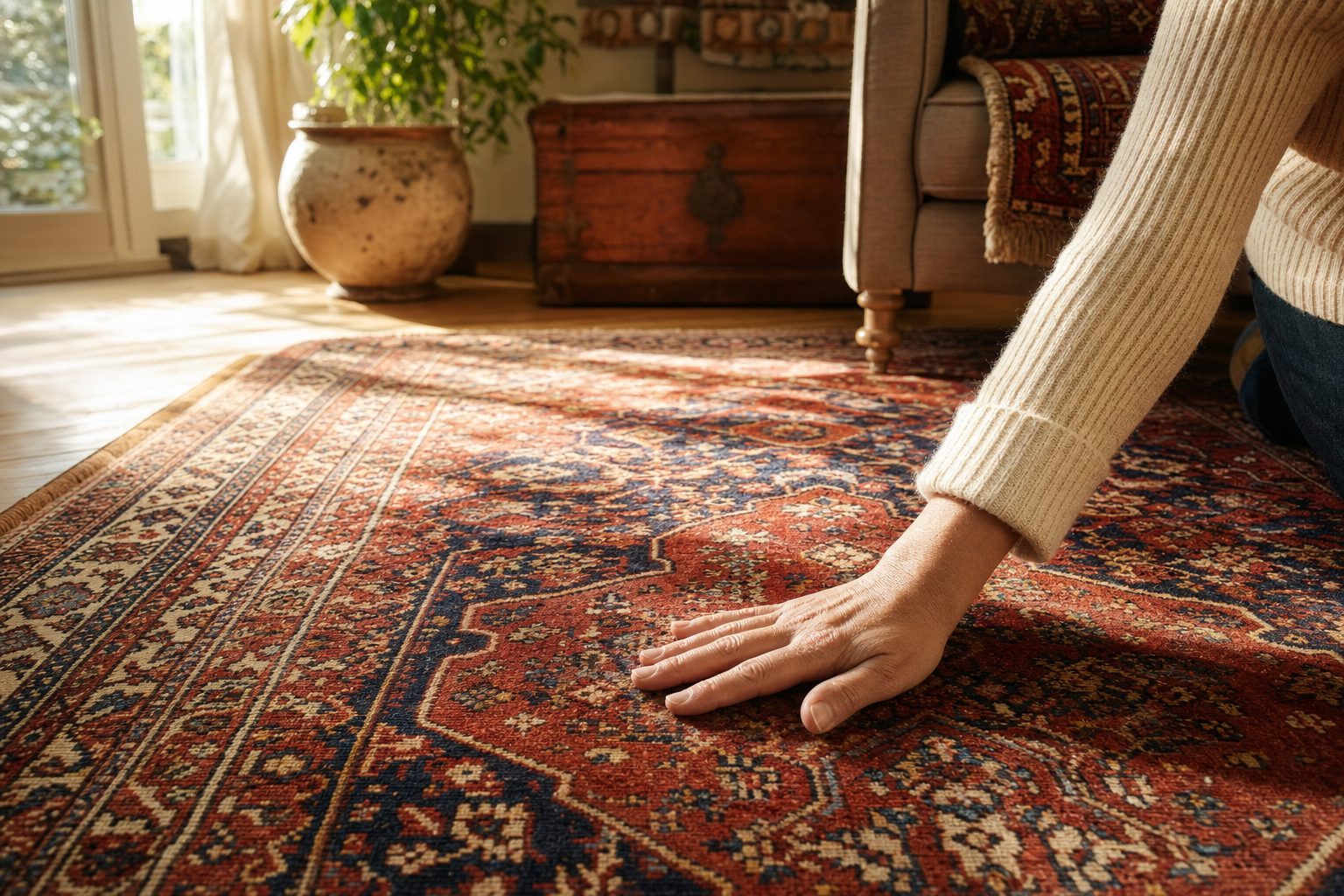
Run your hand across the pile in both directions. On a hand-knotted or hand-woven rug made from quality wool, you'll notice:
- A slight luster that shifts as the light angle changes — this is the lanolin in natural wool fibers catching the light differently at different depths.
- Subtle irregularities in the pile height — not defects, but the natural result of human hands working at slightly varying tension.
- A springy, resilient feel that bounces back after compression.
Machine-made rugs, particularly those made from synthetic fibers like polypropylene or polyester, tend to feel uniform and flat. The pile height is perfectly consistent, the sheen (if any) is artificial and one-dimensional, and the fibers often feel slightly coarser or more plastic-like under close examination.
4. Check the Edges (Selvages)
The side edges of a rug — called selvages — are finished differently depending on how the rug was made.
On a hand-knotted rug, the selvage is typically overcast by hand with wool or cotton yarn, often in a color that complements the field. It may show slight unevenness — a small, honest sign of handwork.
On a machine-made rug, the edges are usually serged mechanically or bound with a uniform tape. The finish is perfectly even and often has a slightly industrial character.
5. Look for Abrash
Abrash refers to the subtle, horizontal variations in color tone that appear in hand-knotted rugs — slight shifts from one shade of red to another, or from a deep indigo to a softer blue, within the same field color. These variations occur naturally when a weaver works from different batches of hand-dyed wool, or when the tension of the loom changes slightly over months of work.
Abrash is considered a mark of authenticity and is prized by collectors. A machine-made rug will have perfectly uniform color throughout — which can look impressive in a photograph but lacks the living, layered quality that abrash gives a handmade piece.
A Note on Hand-Tufted Rugs
Hand-tufted rugs occupy a middle ground that deserves honest attention. They are made by skilled artisans using a tufting gun, and the best examples feature beautiful designs and quality wool. However, the latex backing that holds the pile in place degrades over time — typically 10 to 20 years — and can crumble, causing the rug to shed and delaminate. They are not repairable in the same way a hand-knotted rug is, and they do not appreciate in value. If you're buying for longevity or investment, a hand-knotted rug is the more durable choice.
What This Means for Care
The construction of a rug determines how it should be cleaned and maintained. Hand-knotted rugs with natural fiber foundations require gentle hand-washing — not steam cleaning or the aggressive extraction methods used on wall-to-wall carpet. Steam and high-pressure water can distort the foundation, cause dyes to bleed, and shrink or warp the structure of a rug that took years to make.
Machine-made rugs with synthetic fibers are generally more tolerant of moisture and can often withstand standard carpet cleaning methods — though even here, professional care extends their life considerably.
If you have a hand-knotted or fine flat-woven rug in your home, our care and restoration services are designed specifically for its construction — with hand-washing techniques that protect the foundation, the dyes, and the pile, rather than working against them.
Shopping With Confidence
If you're in the market for a handmade rug, the best protection is knowledge — and the second-best is buying from a specialist who can answer your questions directly. At The Rug Center's collections, every piece is selected with the understanding that a rug is a long-term investment in your home. Our team can walk you through the construction of any rug you're considering, explain its origin and materials, and help you find something that suits both your aesthetic and your practical needs.
Whether you're furnishing a living room in Los Altos, a dining room in Menlo Park, or a study in Atherton, the difference between a handmade and machine-made rug is worth understanding before you commit.
If you already own a rug and aren't sure what you have, we're happy to help you identify it. Visit us or arrange a pickup and we'll give you an honest assessment — along with any care recommendations your rug may need.
The Rug Center · 1347 W El Camino Real, Mountain View, CA 94040 · (650) 815-5606 / (650) 938-7846 · rugcenter@gmail.com — schedule a pickup or visit.
FAQ
Can a machine-made rug ever be worth buying?
Absolutely. Machine-made rugs can be well-designed, durable, and excellent value for high-traffic areas or rental properties. The key is knowing what you're buying so you pay an appropriate price and care for it correctly.
Is a hand-tufted rug the same as a hand-knotted rug?
No. Hand-tufted rugs are made using a tufting gun rather than individually tied knots, and they have a glued latex backing. They are less durable and less repairable than hand-knotted rugs, and they do not carry the same investment value — though many are attractive and well-crafted for their price point.
How do I know if the fringe on my rug is original or sewn on?
Trace a fringe strand into the body of the rug. If it disappears into the weave itself and is continuous with the rug's structure, it is an original warp-thread fringe. If you can see a seam or stitching where the fringe meets the rug's end, it has been attached separately.
Does abrash mean there's a defect in the rug?
Not at all — abrash is a natural characteristic of hand-knotted rugs woven from hand-dyed wool. It is widely regarded as a sign of authenticity and is appreciated by collectors as evidence of genuine handwork. It does not affect the structural integrity or value of the rug.